A ready-made Christmas centrepiece can be very tempting.
It is coordinated, arranged and waiting to go straight onto the table. Unfortunately, that convenience can take a noticeable bite out of the Christmas budget.
If you are saving money, making your own centrepiece is worth considering. You may already have the container, decorations and finishing touches tucked away at home.
The most effective arrangements usually have one clear idea. They do not need a bit of everything from the craft cupboard.
Choose the project that best matches your existing supplies.
Before you start, choose the right size
Place your serving dishes on the table first.
A centrepiece should fit into the space that remains, with room for people to reach glasses and pass food. Sit down and check that it does not block the person opposite.
For a narrow table, use one compact arrangement or move your display to a sideboard.
That is more useful than creating a magnificent decoration that gets evicted as soon as lunch appears.
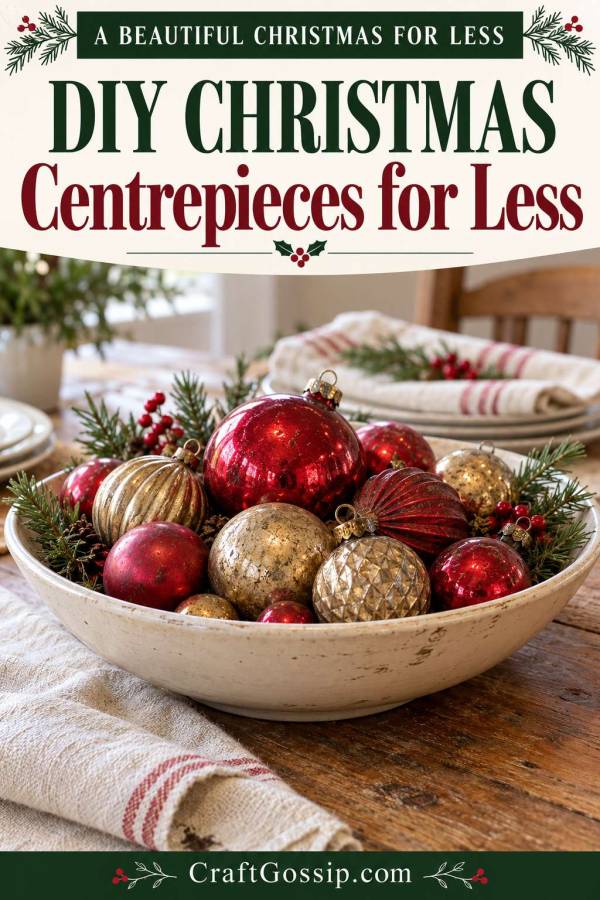
1. A bowl of Christmas baubles
Gather: a shallow bowl, existing ornaments and an optional fabric mat.
Choose one or two colours from your decorations box. Place larger baubles in the bowl first, then fill visible spaces with smaller ones.
Turn hanging loops discreetly towards the middle where practical, and keep the arrangement low and stable.
Our Christmas bauble centrepiece tutorial offers a more structured option. Keep yours loose if you want the ornaments available for other displays.
Keep costs down: use a fruit bowl or serving dish that will not be needed for lunch. Skip floral picks and glitter sprays.
2. A row of small greenery jars
Gather: three or five small recycled jars, water, suitable stems and existing ribbon.
Clean the jars and remove labels if needed. Group similar sizes together or use a repeated ribbon colour to connect different shapes.
Add a little water and a few short stems to each.
Use identifiable plants that are appropriate for your household, avoid sprayed material and keep foliage away from food. Leave unknown berries in the garden.
Keep costs down: use fewer stems and give them space. You do not need to recreate a florist’s bouquet.
3. A generous bowl of citrus
Gather: an ordinary bowl and whole oranges or lemons from your grocery supply.
Arrange the fruit so the bowl looks comfortably full rather than precariously stacked.
Repeat one fruit colour elsewhere through paper place cards or existing ribbon. Orange looks particularly cheerful with white plates and a timber table.
Keep the fruit free of paint, glue and glitter.
Keep costs down: use fruit you will eat afterwards. Buying decorative quantities that go to waste is not a saving.
4. A handmade paper village
Gather: cardstock, scissors, glue and a suitable base or tray.
Our paper Christmas town tutorial provides a detailed starting point.
Choose one paper colour for a simple, coordinated display. A small group of houses can look more polished than a large village with lots of competing colours.
Allow time for cutting and drying. This is a prepare-ahead project rather than something to begin while the guests are parking.
Keep costs down: use suitable cardstock already in your stash and leave out optional embellishments.
5. Small cinnamon bundles on a tray
Gather: cinnamon sticks you already own, ribbon and a small tray.
Follow our cinnamon bundle centrepiece for the basic arrangement.
One or two small bundles can provide a natural detail without taking up much space. Do not expect a strong room-filling fragrance; the effect will vary.
Keep costs down: choose this option only if the sticks are already available or fit comfortably within your budget.
Do you need to add lights?
For a daytime Christmas meal, probably not.
For evening, existing battery lights may be enough. If you need them for repeated use, compare warm-white LED candles on Amazon, including battery costs and secure battery compartments.
Keep lighting suitable for its surroundings and follow the manufacturer’s instructions.
Avoid the “cheap project” shopping trap
Before starting, list everything you would need to purchase.
If a simple arrangement suddenly requires a new bowl, paint, glue, ribbon and specialty decorations, choose a different project.
The centrepiece that saves you the most money is often the one your cupboard can already provide.



Leave a Reply